Summary
In episode 11, we lifted our heads from the computer screens and looked up at space. After a 54-year gap, the Artemis 2 mission has launched with 4 astronauts heading to the Moon. SpaceX has sent more rockets than the entire world combined while Boeing couldn’t even bring its astronauts back. Data centers in space, mission critical programming, permanent lunar bases, and space as “perhaps an even more important technology than AI” — we discussed all of this through the eyes of two dinosaur developers.
Video
Topics
- The Artemis 2 mission and returning to the Moon after 54 years
- From the Cold War to today: how the motivation for the space race has changed
- The China factor: the first landing on the far side of the Moon
- SpaceX vs Boeing: how the private sector surpassed governments
- NASA’s new strategy: the contractor model and fixed-budget approach
- The 10-day Artemis 2 lunar mission with the SLS rocket
- The Boeing Starliner fiasco: Dragon to the rescue
- Permanent lunar bases, minerals, and the land rush
- Radiation, magnetic fields, and protecting computer systems
- Data centers in space: is cooling free? Latency and heat transfer challenges
- The 24-hour solar energy advantage in orbit
- Mission critical programming: why RabbitMQ and Kafka won’t cut it
- C/C++ and Rust: the languages of zero-fault environments
- The Artemis 2 toilet malfunction and engineering in space
- Is AI or space technology more important?
- Star Trek, Captain Kirk, and the Dinosaurs’ Captain’s Log
Deep Dive
Return to the Moon: Not Just a Flag Race — The Era of Space Data Centers and Mining Is Beginning!
1. Introduction: Breaking a 54-Year Silence
Humanity’s relationship with the Moon had been buried in a long, deep silence since those massive Saturn rockets of the early 1970s. The generation that watched Neil Armstrong’s first step on black-and-white televisions — now called “dinosaurs” in the tech world — were actually the last of the greatest visionaries. This 54-year hiatus finally ended when the Artemis 2 mission lifted off.
The four astronauts currently on their way to the Moon are not simply on a nostalgia trip; they’re initiating a massive optimization process that will make humanity’s presence beyond Earth orbit permanent. It’s no longer about planting a flag on that grey soil — it’s about what kind of ecosystem we’ll build there, how we’ll utilize resources, and how we’ll store our data beyond the atmosphere.
2. Why Now, After 50 Years?
During the Cold War, the space race was fueled by the drive for ideological supremacy. But once that race was won, the biggest driving force — political motivation — quickly evaporated.
The United States had shelved its lunar ambitions after establishing overwhelming superiority over Russia. But today, China’s landing on the far side of the Moon has reignited geopolitical competition. According to the timeline set by Artemis missions (2, 3, and 4), humans are expected to set foot on the lunar surface again by 2028 with Artemis 4. This time, the return isn’t a “visit” — it’s aimed at building permanent bases and establishing an economic platform.
3. The New Masters of Space: Governments or Companies?
Space used to be a monopoly run solely by governments with enormous budgets. Today, we see a stark contrast between NASA’s heavily regulated structure — accountable to taxpayers and minimizing margins of error — and the “fail fast” philosophy of companies like SpaceX and Blue Origin.
Government Projects (SLS & Boeing): NASA’s SLS system is a structure where every step must be meticulously examined. This slows processes dramatically. Even more striking was Boeing’s Starliner failure — the crew had to be rescued by SpaceX’s Dragon capsule due to critical problems during the return, providing the clearest proof of the traditional model’s limitations.
Private Sector (Starship): SpaceX has reached a pace of nearly one rocket launch per day. They apply a “fast learning” methodology by testing dozens of Starship prototypes. NASA has now taken on the role of a regulator that uses these companies as contractors while overseeing them.
4. Data Centers in Space: A Thermodynamic Paradox
One of the most fascinating ideas for future strategy is moving data centers to space. Considering the enormous amounts of water and energy that earthbound data centers consume for cooling, the natural cold of space seems invaluable. However, there’s a technical paradox:
The Cooling Problem: Space is extremely cold, but it has no atmosphere. The convective cooling we know on Earth doesn’t work there. There’s no wind to dissipate heat, which means we can only radiate heat away — a massive engineering challenge.
Energy and Latency: A data center placed in the right orbit could receive 24-hour uninterrupted solar energy without cloud cover or day-night cycle interference. However, as distance increases, latency becomes a factor. Not suitable for every type of data, but a tremendous opportunity for storing and processing large datasets.
5. Lunar Mining and Radiation Shielding
The Moon is no longer just a rock; it’s a new economic frontier due to its rare elements and minerals. However, the Moon lacks Earth’s magnetic field shield. This exposes both astronauts and sensitive hardware directly to cosmic radiation. Building permanent bases depends on developing hardware and architectural solutions to block this radiation.
6. Mission Critical Software: From Toilet Malfunctions to Rust
In space, even the most basic human needs require high engineering. The toilet malfunction during the Artemis 2 mission demonstrated how fragile systems can be. The issue was resolved through real-time collaboration between ground control and the astronauts.
On the software side, there’s zero tolerance for error. That’s why highly abstracted queue systems like RabbitMQ or Kafka, or managed languages with garbage collection mechanisms, are not preferred in space. Because memory management and reaction times are critical, C, C++, and Rust — with its modern safety features — have become the foundational languages of space engineering.
7. Conclusion: The Final Frontier
Space technologies are currently a laboratory for innovations that will address sustainability crises on Earth — water and energy conservation. Star Trek’s famous “Space: The Final Frontier” has transformed from a romantic dream into a physical necessity that pushes the boundaries of engineering.
While AI is changing our screens and minds, the real revolution might be happening in orbit above our heads, in that cold void where we’re rewriting the laws of physics. And this time, we’re not going to come back — we’re going to build a new civilization there.
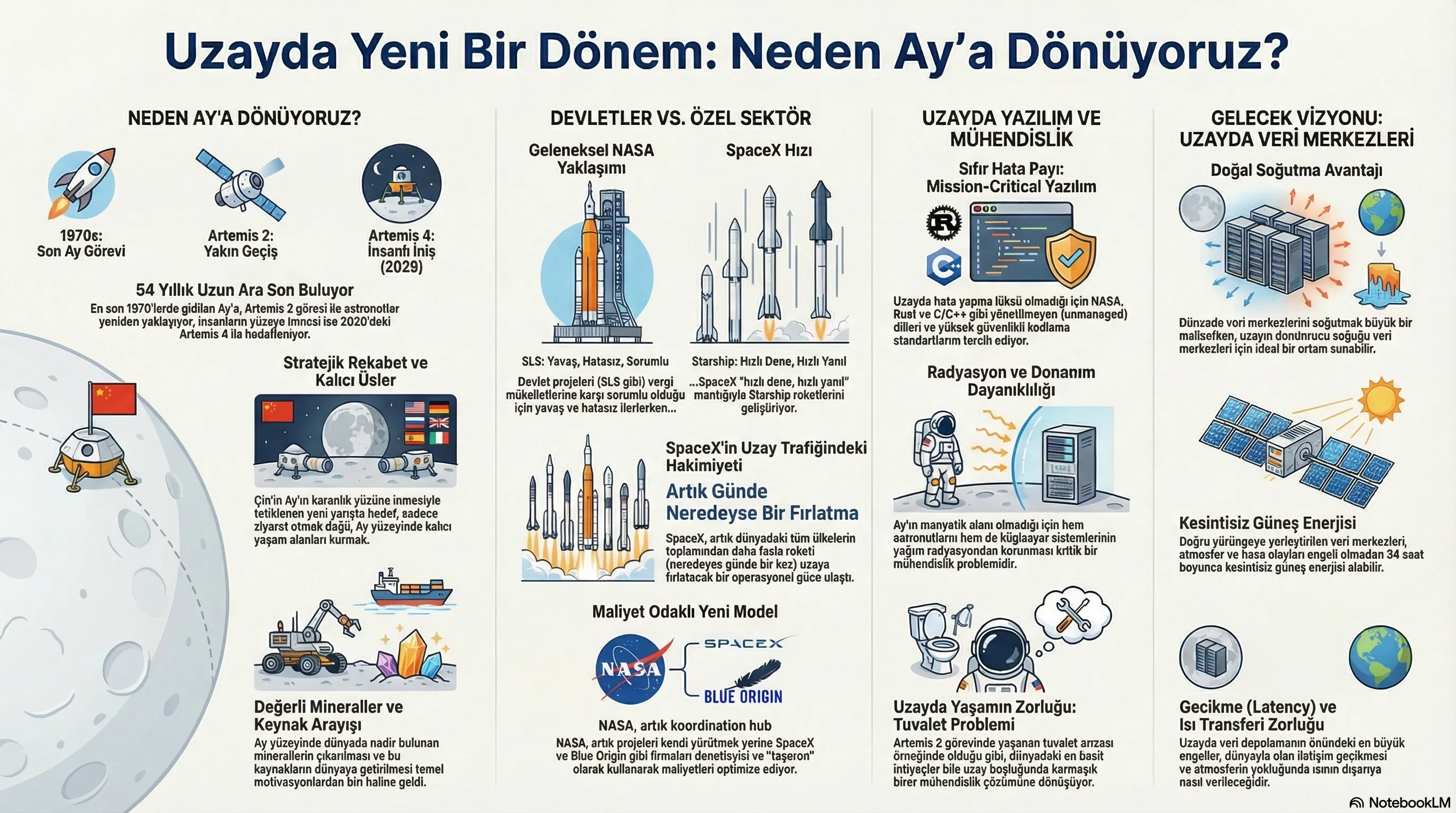
Infographic
Audio Summaries
Brief Overview
Deep Dive
Resources
- NASA Apollo 11 Documentary — Original footage of the first Moon landing
- NASA Challenger Disaster Footage — Archive footage of the 1986 Challenger disaster
- You can also explore this episode’s content on NotebookLM.