Summary
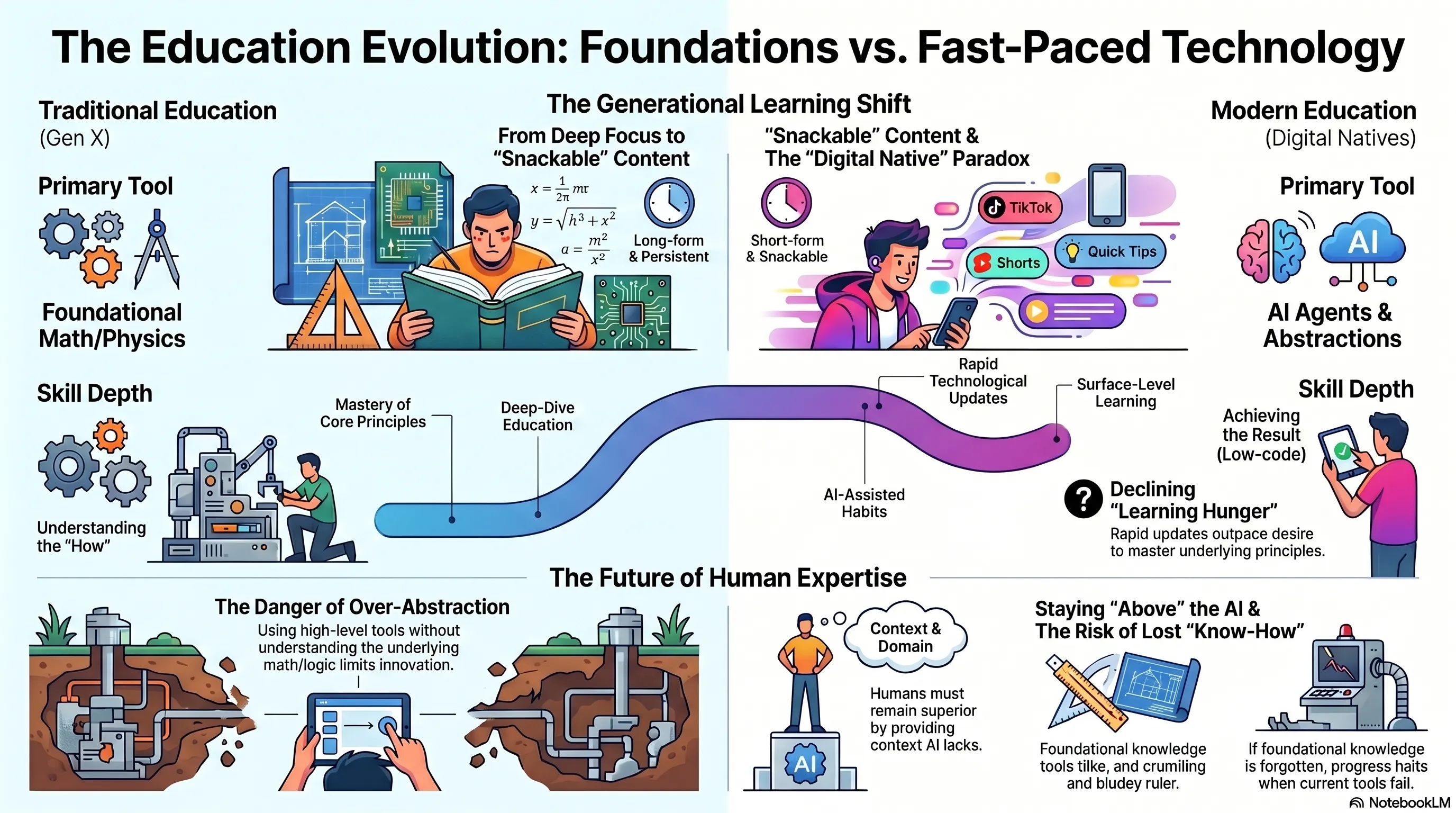
After years of teaching, the picture we see is shifting: the appetite for learning isn’t where it used to be, cameras stay off, abstractions erode the foundational knowledge beneath them with every passing day. In this episode, Burak Selim Şenyurt and I tackled a difficult question: “Can we still be educated?” A conversation that travels from the university lectern to the age of bite-sized knowledge, from the “I’m just an operator” feeling while learning quantum computing to the civilization in Forster’s “The Machine Stops” that lost its manual — our need for knowledge isn’t changing, but how we cultivate the mind that carries it remains very much in question.
Video
Topics
- Observations from Burak’s lectures in university and the “Sektör Kampüste” (industry-on-campus collaboration) program
- Trying to understand the new generation without falling into the “back in my day” trap
- The 45-minute attention span no longer making sense to today’s student
- Cameras-off classrooms and the exhausting reality of teaching to a black screen
- The lingering aftershock of the pandemic on remote learning
- Erosion of foundational knowledge underneath abstractions: the quantum computing example
- Square roots, complex numbers, matrices, vector math — being able to stack gates but unable to design algorithms
- The “swipe reflex” created by TikTok and YouTube Shorts culture
- The atrophy risk for deep thinking in the age of bite-sized knowledge
- The industry’s rising baseline: Dependency Injection, Clean Architecture, Docker
- Using AI like a hammer — not surrendering to it
- AI’s inability to say “I don’t know” and its tendency to confidently hallucinate
- AI outputs that can be less productive than the most junior developer
- An open call to young developers facing “AI does your job” rhetoric
- From transistors to Angstrom scale: the critical decline of know-how at the lower layers
- A civilization that can no longer build the iPhone in its pocket from scratch
- Forster’s “The Machine Stops” and a society that lost its manual
- The need for knowledge isn’t changing — the only constant is learning
Deep Dive
1. A Generation Born to Screens — and a Cognitive Rupture
The fundamental question of modern pedagogy is no longer “What are we teaching?” — it’s “Can we still be educated?” In today’s world, an ontological rupture has opened up between the generation that grew up in a silence without internet and smartphones, able to focus on a single subject for 45 minutes, and the generation born inside the tablet. In a world where children are “glued” to their screens, attention is measured in seconds.
This isn’t a simple generational conflict — it’s a deep cognitive estrangement about how knowledge itself gets processed. It’s easy to surrender to the “back in my day” narrative; but that narrative papers over the fact that the new generation was genuinely born into a different world. In an era where the 45-minute classical attention span has been replaced by infinitely scrollable content, the nature of education is being shaken at its roots. What we need to do as educators is not mourn a lost golden age, but find the path to reach this new mind.
2. The Vanishing Appetite for Learning and Passive Classrooms
The desire to learn has been humanity’s most fundamental drive; but a striking diagnosis is possible today — that appetite is steadily shrinking. Burak’s first-hand experience in projects like “Sektör Kampüste” reveals classrooms now echoing with the silence of passive participants. The black boxes hiding behind closed cameras make up half the room.
This isn’t pedagogical failure — it’s a mental fatigue caused by speed. The pace at which topics flow now leaves the question “Which of these matters for my future?” unanswered. The creative energy inside students dissipates in the noise of too many tools. The pandemic’s aftershock hasn’t fully passed either — bodies adapted to remote learning still create a strange isolation for instructors speaking to the camera.
3. The Trap of Abstractions and the Erosion of Fundamentals
In software and engineering, abstraction can look like a blessing that simplifies work — but it can also become a monster that erases the foundational knowledge beneath it. Alper’s experience stepping into the world of quantum computing is a vivid example: in a field that should rise on probability theory, vector mathematics, complex numbers, matrices, and the fundamental theorems of physics, a chasm opens between using the tools at the top layer and designing an algorithm with architectural intelligence.
“It feels like I’m only at the top — I can stack gates one after another… but if I really have to design an algorithm, I feel like I never actually learned the things I needed.”
The accelerators at the top layer can make us productive — but when we forget the mathematics and logic at the bottom, our ability to generate original ideas atrophies too. The difference between remaining an operator and becoming an architect lies hidden in those foundations we no longer see. And this isn’t unique to quantum — from Dependency Injection to Clean Architecture, from Docker to microservices, the rising baseline of the industry is making the layer beneath us more invisible with each passing year.
4. Shorts Culture and the Bite-Sized Knowledge Dead End
The zeitgeist dominated by platforms like TikTok and YouTube Shorts is sentencing the mind to seconds-long rewards and snackable knowledge. The swipe reflex — the habit of flicking past — paralyzes the capacity for deep thought. Knowledge taking on the costume of entertainment (edutainment) makes retention and internalization nearly impossible.
Real learning, by contrast, requires slowing down, taking breaks, digesting. Today’s educators have to stand on a knife-edge between surrendering to this speed and resisting it. Total resistance means isolation; total surrender means shallowness. Modern education must remain a construction process where the mind slows down to go deeper — but with a bridge built from the language the new generation already speaks.
5. AI Is a Hammer — You Are the Craftsman
AI may be the loudest hype wave of our time, but positioning it correctly is vital. AI is just a tool — like a keyboard, a mouse, a hammer. But this tool lacks context and domain knowledge — instead of honestly saying “I don’t know,” it confidently hallucinates. From a contextual-awareness standpoint, it often produces output less useful than the most junior team member on staff — just throwing what it knows, without questioning the context.
This generates a critical warning for younger developers: If you accept the perception that AI does your job, then nobody in this sector will have a job left. If your approach is “let it write everything for me,” you’ll be eliminated over time, like people doing the work machines were built to do. The ones who will keep the industry standing are the master minds who can interpret AI’s output with their own intelligence and stay above it. Those who design the wall, not just swing the hammer, will be the ones who matter.
6. The Civilization’s Memory Loss: How Did We Get Here?
Technology is a tower built by stacking layers; but as the tower rises, we forget how the lower layers were built. Today, as we try to push transistors from nanometers down to Angstrom scale — a tenth of a nanometer — the number of people who know how to purify that silicon and produce those wafers is dropping to critical levels.
If our technological infrastructure went silent one day, it might take centuries to rebuild even the iPhone in our pocket. Because we no longer own that knowledge — we are only the users of the machines that operate it. Civilization’s progress is cyclical: sometimes, to fit more data into the smallest area, you have to ask “How did we used to do this?” and return to the most basic algorithms and flow diagrams. The hard truth is that a civilization that loses its memory cannot progress; it becomes a guardian praying the thing in its hands doesn’t break.
It’s exactly here that Forster’s 1909 story “The Machine Stops” turned into the episode’s closing metaphor: a future where humanity lives underground, all its needs supplied by a single device called “the Machine,” but no one understands how the Machine works anymore. When the Machine begins to break down, no one can repair it — and civilization collapses with it. The society that watches over the device like its own eyes, but has no knowledge to look inside it, is a striking allegory for the edge we’re standing on today. We explored this metaphor in depth in our blog post: The Machine Stops — What Forster’s 1909 Story Tells Us Today.
7. Redefining the Manual
Education isn’t the transfer of raw data from one source to another — it’s the process of converting data into value, experience into wisdom, and internalizing both. No matter how fast technology changes, one truth stays constant for humanity: our ontological need for knowledge, and the unchanging value of the mind that holds it. The person who possesses knowledge is irreplaceable by any tool — only the tool in their hand changes.
AI and the new generation of tools are inevitable; but the new manual for education is to cultivate the master minds that operate these tools while preserving the foundational cycle (know-how). We have to stop dismissing the knowledge of the past — and start building a new world on top of it. Instead of treating the old lessons full of algorithms, flow diagrams, and structured thinking as outdated, we need to return to those pages when we hit a wall on today’s project, and see that the solution was hiding there.
The only constant is learning. Underlining this sentence in the age of bite-sized knowledge may be the single most important job we have as educators.
Infographic