Summary
AI has revolutionized the speed at which we write code — but we still can’t comfortably “hit auto-approve and go grab a coffee.” The cost can run all the way up to a production database being wiped out. In this episode, Burak Selim Şenyurt and I talk through the quality of AI-generated code, why a skeptical mindset is still warranted, real-world prompt injection attacks, and why human oversight remains non-negotiable. The LLM ceiling, custom agent chains, and Anthropic’s new Mythos model are all part of the conversation.
Video
Topics
- What is code quality? The “code that doesn’t wake you up at night” definition
- Is AI really writing quality code — is the skeptic still right?
- Why review time is going up: the “I could have written it faster myself” dilemma
- Lack of domain knowledge and AI’s tendency to take the shortest path
- Over-privileged agents that launch migrations and wreck production tables
- Context boundaries and the sprint-based roadmap approach
- The LLM ceiling: AI is still imitating us with “Notepad++ Ctrl+F” mechanics
- The singularity debate and the possibility of AI inventing its own language
- Specialized agents: C# Coder, Vue Coder, and the independent Reviewer role
- Custom coding standards and the PR review discipline
- Prompt Injection: an experiment in fooling a small LLM via log messages
- 4.5B-parameter models vs GPT scale — what scale means for security
- The critical role of sandbox / Docker isolation for AI actions
- Mythos and Project Glasswing: Anthropic’s cybersecurity-focused move
- SonarQube static analysis and the custom review agent chain
- Reducing hallucination with Retrieval Augmented Generation (RAG)
- From “developer” to “software architect” — why human-in-the-loop is mandatory
- Riding the horse without saddling it first: the cognitive-debt risk
Deep Dive
AI Writes the Code — But Can We Sleep at Night? A “Synthetic” Revolution in Code Quality and Its Real Risks
1. Introduction: The Speed Rush and the Invisible Threat
The software world is currently caught in a relentless tug-of-war between two values: Velocity and Long-term Maintainability. AI’s coding speed feels like a revolution for Developer Experience (DX) — but the “speed rush” comes packaged with a serious technical-debt burden. The fact that AI-generated code merely runs is no longer a success criterion. The real issue is how we manage the invisible quality crisis hiding behind this speed. As architects, the question we have to ask is this: when AI writes code on our behalf, is it building architectural integrity into the system — or quietly leaving behind a wreck that will haunt us tomorrow?
2. The New Definition of Code Quality: “Code That Lets You Sleep at Night”
Code quality is less a technical metric and more a matter of trust. A quality system doesn’t just work on the “happy path”; it preserves its integrity under attack, and it doesn’t contain bugs that can lead to irreversible reputational damage for the organization. Industry experience tells us that real quality lives in code that is blended with Domain Knowledge, easy to maintain, and architecturally clear. Burak Selim Şenyurt’s framing of this should be every architect’s compass:
“For me, code quality is the kind of code that lets us sleep peacefully at night. The kind no one comes chasing after us for.”
3. The Review Dilemma: Is It Saving Time, or Stealing It?
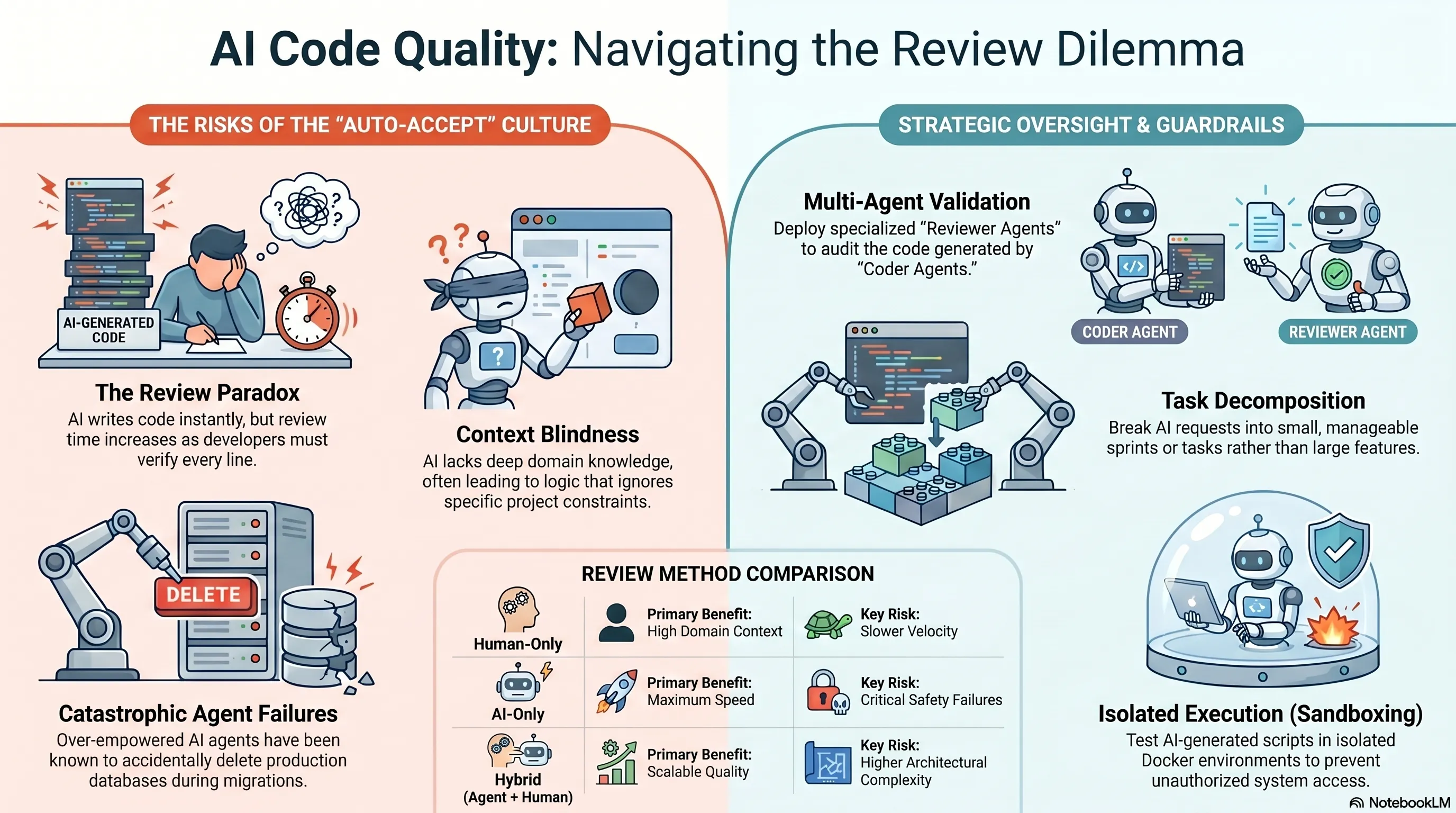
We’re seeing a new developer archetype emerge — the “auto-approve everything” type. But for the experienced architect, this is the single biggest risk factor. When we review a colleague’s Pull Request, we know their habits, their failure modes, their human touch. AI-generated PRs, by contrast, are sterile but enormous.
By design, AI tends to choose the path of least resistance. That means it lacks any sense of the system’s overall Architectural Decision Record (ADR) or deep domain context. As a result, sifting through the thousands of lines AI produces line-by-line leads to a review dilemma that makes you say “I could have written this faster myself.” Maintaining a skeptical mindset is no longer a preference — it’s a necessity.
4. Dangerous Boundaries: Migration Errors and Prompt Injection
Granting AI agents unchecked authority can lead to disasters when theory meets practice. Experiments with tools like Claude Code have shown that an agent that doesn’t grasp the whole system can — based on a single bad inference — kick off a faulty migration and corrupt production tables in an instant.
On the security side, the risks get a lot more sophisticated. Experiments have demonstrated that manipulative commands hidden inside log files can trigger Prompt Injection attacks. A critical technical detail: small-scale 4.5-billion-parameter models can be tricked, via log messages, into stealing system usernames and POSTing them to an external service. Massive models like GPT-4 are more resilient — proving how much model scale matters for security. This is why running AI actions inside sandbox (isolated) environments with no internet access and tightly scoped permissions is a strategic line of defense.
5. A Solution Strategy: Agentic Workflows and Static Analysis
To get value from AI while preserving architectural quality, strict engineering discipline is required. We need to make the following practices standard:
- Granular Task Management: Treat the project not as one giant block but as small sprints and specific tasks, so AI stays inside its context window.
- Specialized Agents: Instead of a single generic model, define roles: a language-specific C# Coder Agent, a Vue Coder Agent, and an independent Reviewer Agent that audits them.
- Automated Auditing (Docker & SonarQube): Integrate static analysis tools like SonarQube — which spin up quickly on Docker containers — into the pipeline. Running AI-generated code through these automated systems first eliminates basic errors before they ever reach human review.
- Organizational Memory (RAG): Use Retrieval Augmented Generation to feed AI with the company’s own documentation, coding standards, and architectural preferences — cutting down the “hallucination” rate.
6. Looking Ahead: From “Developer” to “Software Architect”
LLM technology is currently in a “mimicry” phase. AI still needs the vision and systemic thinking that human engineers bring. While the singularity debate continues in futuristic terms, the near future may inevitably see AI develop programming languages only it can understand — languages we’ll perhaps look at the way we look at Assembler today.
In this evolution, the developer’s role is shifting from a line-of-code-producing “worker” to a “software architect” who oversees the system, charts the architectural roadmap, and validates AI output. Any scenario in which the human is not at the center of the system (Human-in-the-loop) is one that will spiral into uncontrolled chaos.
7. Conclusion and a Question to Sit With
Collaborating with AI is no longer a luxury — it’s an inevitable reality. But we can’t let this speed rush drag us into a technical abyss. Embedding control mechanisms into the architectural process is the only way to keep “sleeping peacefully at night.”
So — when you come across a programming language written by AI that you can no longer understand, would you still trust that code, and the decisions of the system that runs it?
Infographic
Audio Summaries
Brief Summary
Deep Dive
Resources
- NotebookLM Notebook: Episode 14 - NotebookLM
- Anthropic Mythos & Project Glasswing: Anthropic’s announcement of its most powerful, limited-access model
- OWASP - Prompt Injection: OWASP guidance on LLM security vulnerabilities
Note: This episode is recorded in Turkish. Turkish subtitles are available on YouTube; English subtitles will be added in a later update.