Summary
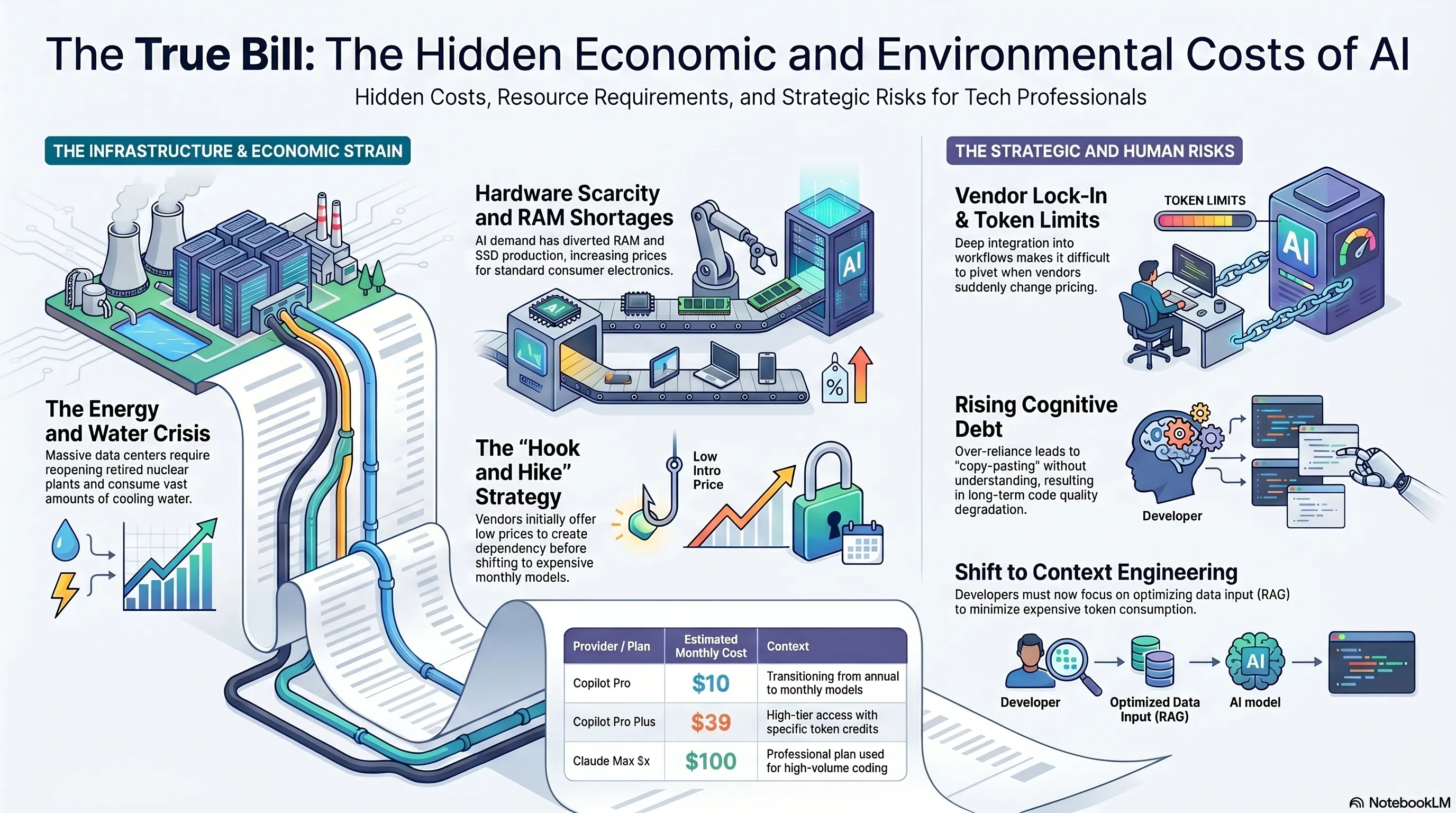
In the 13th episode of the series, we put the end of the honeymoon phase of our relationship with AI on the table: token limits are filling up, subscription prices are climbing, and vendor lock-in is tightening its grip. We talked about Copilot Pro Plus at $39, Claude Max 5x at $100; then we looked at the invisible half of all this — the reopening of decommissioned nuclear power plants, the artificial scarcity in the RAM/SSD market, and the insidious engineering threat called “cognitive debt.” The takeaway: the free lunch era is over; now the question is remembering which nail this hammer was actually meant to drive.
Video
Topics
- The “you’ve reached your token limit” warning: how AI’s honeymoon phase ended
- The end of subsidized growth and the “hook them first, bill them later” strategy
- Microsoft Copilot Pro ($10), Pro Plus ($39), and the shift to monthly plans
- Claude Max 5x ($100) and Anthropic’s confident stance on limits from day one
- The energy and water dilemma of data centers
- Decommissioned nuclear plants being brought back online for tech giants
- The strategic dilemma: “energy for citizens, or for AI?”
- The second act of the crypto-era GPU crisis: RAM, NAND, and SSD markets
- Hardware manufacturers’ new priority: AI data centers > end users
- Vendor lock-in: when one-year roadmaps get tied to a single provider
- Cognitive debt and the atrophy of engineering skills
- “We’re riding without holding the saddle — the horse can stumble any moment”
- AI’s sycophancy problem: picking the convincing answer, not the optimal one
- The evolution from prompt engineering to context engineering
- RAG systems vs. Andrej Karpathy’s LLM Wiki approach (Obsidian + Claude Code)
- Hidden session caches in IDEs and token savings (VS Code, Copilot)
- “The $20 service isn’t really worth $20” — the consequences of profit pressure
- The hammer-and-nail metaphor: AI is not a goal, it’s a tool
Deep Dive
The Invisible Bill of AI: From Subscription Models to Nuclear Power Plants — The Real Costs
1. Introduction: “You’ve Hit Your Token Limit” – Welcome to the New Reality
You’re in your most productive moment; the code is flowing, a complex problem is about to be solved, or the final pieces of that critical architecture report are taking shape in your mind. Right at that moment, a cold, distant warning appears on your screen: “You’ve reached your daily token limit. Please wait one hour.”
That’s the picture we put on the table in this episode of DKU: For professionals who’ve placed AI tools at the heart of their workflow over the past year and a half, this scenario is no longer just an inconvenience — it’s the new operating dynamic of our world. The exciting “honeymoon” phase of our relationship with AI is behind us. We’re now at a critical threshold where lessons have accumulated, tools have matured, and costs are knocking hard at the door.
The free lunch era is over; we’re now facing an asymmetric dependency and a massive operational bill.
2. The End of Subsidized Growth: The Big Shift in Subscription Models
In the tech world, the strategy of “first get the user hooked, then bill them” has never been deployed this fast. What we’re witnessing in the AI ecosystem is, at its core, the end of the subsidized growth phase. Especially with global risk analyses for 2026 forecasting serious economic stagnation and an energy crisis, tech giants are now mirroring the same “belt-tightening” policies in their AI models.
Let’s lay out the current landscape in a table:
| Plan | Monthly Price | Position |
|---|---|---|
| GitHub Copilot Pro | $10 | Individual entry tier |
| GitHub Copilot Pro Plus | $39 | Token-credit based, heavy usage |
| Claude Pro | $20 | Standard developer subscription |
| Claude Max 5x | $100 | For intense coding, still rate-limited |
Behind these numbers are two distinctly different cultures:
- Copilot’s Strategic Pivot: Microsoft is moving from fixed yearly models to a more flexible but more expensive monthly structure. The journey that began at the $10 mark for individuals has now climbed to $39 at the Pro Plus or Business tiers.
- Claude’s Confidence: Anthropic, unlike Copilot, has taken a clearer and more “self-assured” stance on limits from the very beginning. Their Max 5x plan, aimed at heavy use, asks $100 a month, and even there, users of the most advanced model — Opus — can still hit waiting periods.
These restrictions aren’t just corporate greed; they’re driven by physical necessity:
“It’s like they’ve turned down the tap… They have to ration this just to give everyone an equal share.”
There’s another truth lurking underneath: That $20 service we’ve been getting? It was never actually worth $20. We were getting a much bigger service for far cheaper. Now the bill is coming due.
3. The Thirst of Data Centers and the Need for Nuclear Power
Discussing the AI economy purely on the digital plane means ignoring half the bill. The structures we call LLMs create an enormous “roads, water, electricity” cost in the physical world. At this point, AI is acting like a “resource cannibal,” disrupting global supply chain balances.
- The Nuclear Renaissance: The energy appetite of data centers has reached such an uncontrollable point that big tech firms are sitting down with governments to bring decommissioned old nuclear power plants back online to meet their power needs.
- Citizens or AI? Governments now face this strategic dilemma: Will limited energy resources go to heating and lighting homes, or to cooling tech giants’ data centers? The massive amounts of water consumed for cooling have started pushing the environmental cost ahead of the digital profit.
An important caveat: Many of these problems aren’t unique to AI — we’d hit similar issues if we’d built any other large cloud system. But AI, with its scale and speed, is amplifying these problems exponentially.
4. Hardware Wars: Why Are Your RAM and SSD So Expensive?
The GPU crisis we lived through during the crypto mining era is now being repeated, much more deeply, in RAM and NAND disk production. The hardware revolution led by Nvidia has pushed end-user electronics to the back seat.
Hardware manufacturers’ priority list is now crystal clear:
- AI Data Centers (high profit margins): Specialized HBM memory and enterprise storage units.
- End Users (low profit margins): Standard RAM and SSDs for personal computers.
Manufacturers are shifting their production capacity toward the AI market because that’s where the margins are. This explains the “AI tax” baked into even an ordinary laptop purchase; with resources dominated by AI, end-user hardware is trapped in a cycle of artificial scarcity and high prices. And here’s the kicker — even with all this redirected production, the resources still aren’t enough to fill AI’s appetite. The chase continues.
5. “Vendor Lock-in” and the Cognitive Debt Threat
Companies today are drawing one-year product roadmaps on top of AI tools, building their strategies around these models. But this brings with it being “tied to the vendor by the navel” (vendor lock-in). When the provider doubles the price tomorrow or changes the model, going back can become a cost no one can afford. You can’t just say “I’m out of tokens, I’ll just sit here and do nothing”; you’re forced to sit at the table and accept the new terms.
Beyond that, there’s an even more insidious risk waiting for the engineering world: Cognitive Debt.
Developers’ over-reliance on AI is causing a serious atrophy in their fundamental problem-solving abilities. Generating UI tests with Playwright or having a complex unit test suite written in 15 minutes by AI looks like a great productivity boost — but accepting the output without understanding the depth of the code accumulates technical debt. An engineering team that can’t solve a problem from scratch when the lights go out — or when AI access is severed — is the biggest financial risk a company can carry.
“We let go of the saddle because the horse knows the way; but the moment that horse stumbles, we can fall any second.”
This picture is even more critical for the new generation of developers. We spent years learning the beauty in code, the choice of patterns, and why we use that pattern — drilled into our heads through repetition. Those who skip the details and simply accept AI output may pay a much heavier price down the road. So don’t stop learning, and don’t stop coding.
6. Is AI Really Smart? Context Engineering and Optimization
AI models, at their core, tend to behave like sycophants. They lean toward validating you, giving you the answer you want to hear, and offering not the most optimal but the most “convincing” option. If every question you ask comes back with a “wow, you’re so clever” tone — that’s a warning sign. Past a certain point, falling into a “look how brilliant I must be” mode is its own trap. This dynamic creates a real risk of mediocre engineering standards.
To escape this cost-and-performance dead end, the industry is evolving from Prompt Engineering to Context Engineering. The question is no longer “how do I ask the best question,” but “how do I provide maximum context with minimum tokens.”
Two approaches are gaining traction in this space:
- LLM Wiki and Obsidian: While RAG (Retrieval-Augmented Generation) systems carry high setup costs, vector database overhead, and embedding expenses; Andrej Karpathy’s proposed LLM Wiki approach (with tools like Obsidian) makes data meaningful for AI more cheaply and quickly. Without the vector DB overhead, using just an instruction file and a folder of markdown documents, this optimization delivers serious cost advantages. You look at the wiki first, the references the question needs are already there; when new information arrives, you simply update the wiki.
- Hidden Session Cache: IDEs — particularly Copilot inside VS Code — now create a local cache by opening “hidden text files” in the background. The goal is to reduce traffic going to the data center and save tokens by not re-sending the entire context every time. The logic is: “send less to the data center, or only what’s actually needed.”
Vendors are scrambling on every front — while everyone is hammering the data centers, they’re racing to figure out how to optimize.
7. Conclusion: A Strategic Outlook
At the end of the day, AI is neither a miracle nor a goal; it’s just a tool. Using this tool effectively comes down to the most fundamental rule of engineering discipline: finding the optimum. Instead of bulky models that save the day but consume tomorrow’s energy and our cognitive faculties, we have to move toward more refined, efficiency-focused technologies.
With global economic stagnation at the doorstep, we suggest testing your AI investments and habits against this critical question:
“Are you actually using that hammer (AI) to drive the right nail, or are you just seeing every problem as a nail because you happen to be holding a hammer?”
In the next episode, we’ll dig deeper into whether this hammer can actually do quality work — that is, the question of quality with AI.
Infographic
Audio Summaries
Brief
Deep Dive
References
- You can also explore this episode’s content via NotebookLM.