Summary
In the early days of the generative AI boom, the whole thing felt like a subsidized buffet: tools were free, entry costs were close to zero. In Episode 19 we talk about what was really going on underneath — a “land and expand” play funded by venture capital to get everyone hooked before the inevitable correction. Now that correction is here. Anthropic has reported its first profit, an IPO is being discussed, the chip and RAM crunch is bleeding into console prices, and token limits are forcing people to think before they prompt. So where is this new economy headed — a permanent layer of the market, or a loop feeding on itself? Two “dinosaur” developers talk it through from the user’s seat: what actually lands in our wallets and our workflows.
Video
Topics
- The end of cheap and free AI
- “Land and expand”: pricing below cost to build habits
- Anthropic’s first reported profit and IPO talk
- OpenAI’s pivot toward the enterprise segment
- Nvidia–OpenAI–Oracle: circular investment and “where is the real money?”
- Is AI a bubble or a lasting economy?
ROIand the sustainability question- The chip,
RAMandNANDcrunch; its hit on Xbox/PlayStation prices Data Centercosts and the energy bottleneck- Token limits and the 20-dollar subscription experience
- Local or
Cloud? Hybrid models andSLMs - The 192 GB
RAMbarrier and Apple’s local-model efforts - Privacy, data sovereignty and battery life trade-offs
- Sam Altman: is AI the new electricity and water?
- Token optimization becoming a discipline of its own
- A new engineering layer:
MCP,RAG,Context Caching,Guardrails - The “Dead Internet / Dead Economy” theory and a nod to The Matrix
Deep Dive
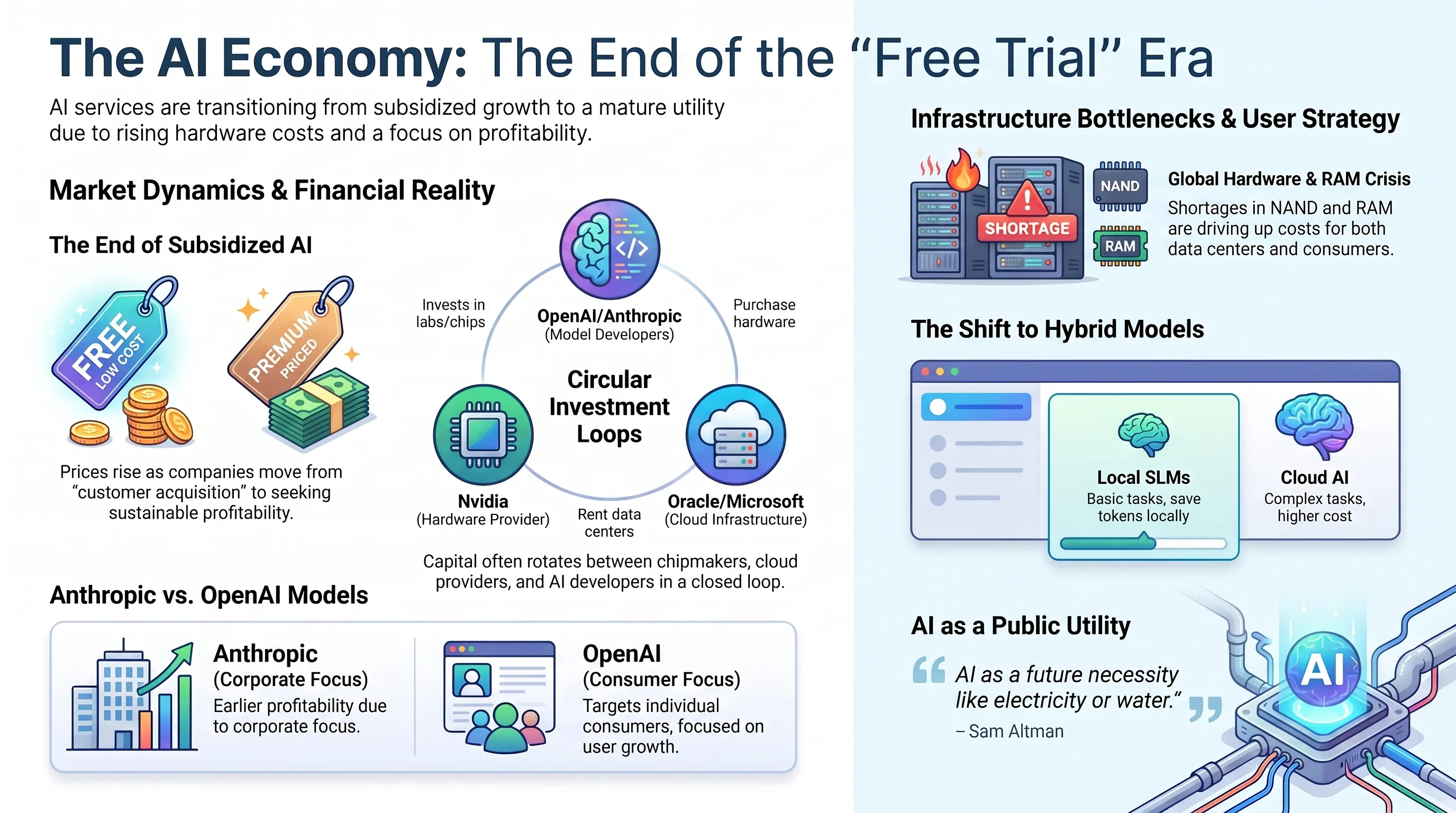
The “free buffet” phase of AI is officially closing. The low prices we got used to were companies pricing below cost to pull users into the ecosystem. Now the focus is shifting from raw user counts to return on investment (ROI). This isn’t a collapse — it’s prices catching up to reality. Here are the five threads we pulled on in this episode.
1. Profitability Finally Shows Up
The phase where companies ate the cost to habituate users is over. Anthropic’s first reported profit and OpenAI’s harder pivot toward the enterprise segment both signal that the metric has changed: it’s no longer just how many users you have, it’s what they pay back. The 20-dollar subscriptions many of us hold were priced well below the value they deliver — and the market is now closing that gap.
As Burak put it in the episode: you pay 20 dollars, but the thing it does for you is worth a good deal more than that. The gap between AI’s value and its price tag is exactly what’s being corrected.
2. AI as a Public Utility (the Sam Altman Vision)
Speaking at the BlackRock summit, Sam Altman framed AI less as a software product and more as fundamental infrastructure — something you’d buy and bill like electricity or running water. Just as it’s hard today to reach many essential services without an internet connection, AI is drifting toward being a mandatory subscription. That also ties us, for the most part, to the Cloud-side “grid”: AI stops being a novelty and becomes a recurring line item.
3. The Hidden Hardware Tax (RAM and the Chip Crisis)
Expecting costs to fall through software optimization alone can be misleading — there’s a heavy-industry problem in the way. The crunch is no longer just about GPUs; it has spread to RAM and NAND storage, and it’s deep enough that AI data centers’ appetite is keeping Xbox and PlayStation consoles from holding their old prices. Energy and hardware bottlenecks make AI one of the most expensive things to actually run.
4. The Optimization Pivot (Tokens as Currency)
As compute gets pricier, “ask for everything” gives way to “use what you need.” In a quietly ironic twist, AI hands work back to the human: to avoid burning expensive tokens, we train ourselves to write tighter, clearer prompts. Precision becomes a financial necessity, not just a technical preference. Surviving this shift means newer competencies — token-efficient prompting, juggling local SLMs against Cloud APIs, and culling data so only the good stuff reaches the model.
5. The “Dead Economy” vs. a New Engineering Frontier
The industry sits between a pessimistic “Dead Economy” theory and a genuinely new engineering frontier. Skeptics point at the circular flow of capital — Nvidia invests in AI startups, those startups pay Oracle for compute, Oracle buys more Nvidia chips. But that loop is being met by real new layers: RAG (Retrieval-Augmented Generation), MCP (Model Context Protocol), Context Caching, Guardrails and Red Teaming are becoming standard tooling, and big players like IBM investing here suggests a permanent, complex layer rather than a passing phase.
We closed with the Matrix metaphor: if we manage this “grid” well, we get to be its architects; if we don’t, we risk becoming the “batteries” powering an automated loop. The question for the coming decade isn’t only whether AI takes our jobs — it’s whether we can afford the AI utility bill, and who gets to hold the optimization levers.
Infographic