Summary
Written by: Alper Konuralp
In Episode 15 of our Dinozorlarla Kafa Ütüleme (Ear-Bending with Dinosaurs) series, under the title “Are We Still Trainable? Did We Lose Our Manual?”, we discussed three things:
- Where learning is going in the age of fast-food knowledge,
- How abstractions erase fundamental knowledge,
- Where AI is taking this equation.
In the middle of the conversation, I started telling a story I half-remembered: “there was this book or maybe a film, but I can’t remember the title right now” — humanity living underground, dependent on a massive “Machine”, no one understanding how the Machine works, and finally the Machine stops and civilization collapses. Neither Burak nor I could come up with the title at that moment. We tracked it down afterwards: E. M. Forster’s 1909 short story “The Machine Stops”. The year was 1909. The telephone was still a luxury, radio was in its infancy, forget the internet — the phrase “video conference” didn’t even exist in science fiction. And in that world, Forster sat down and wrote a story that today reads almost as if he had taken a photograph of it. It blew our minds. Someone being this clear-eyed in 1909! Astonishing. So that’s why we felt compelled to look into this story. Let’s dig in.
Where to Read the Story
Later sections of this post touch on parts of the plot. If you’d rather read the story yourself first, this is your starting point before going further:
-
English original (PDF): Machine_stops.pdf — about 12,300 words, short enough to read in a single evening. The English original is in the public domain in US-based archives; copyright status may vary by country.
-
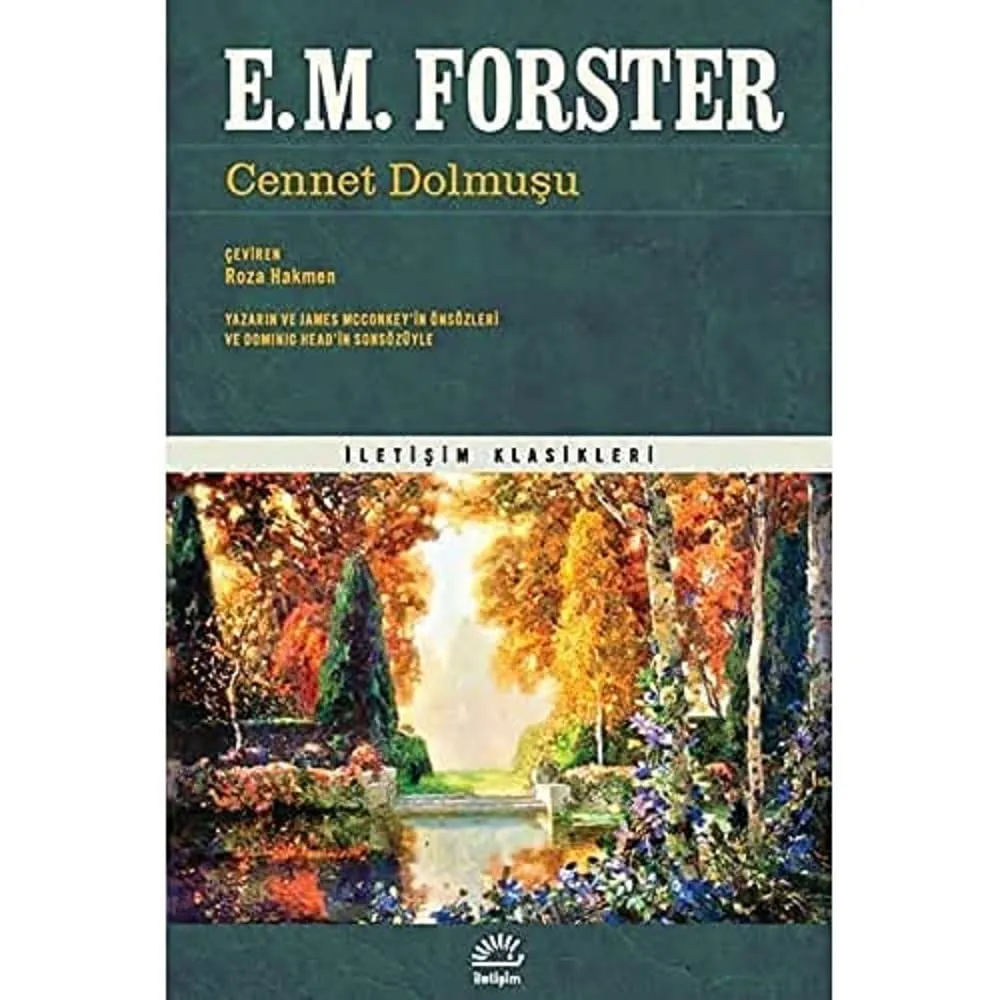
Turkish translation: Roza Hakmen’s translation is available in the Forster short story collection Cennet Dolmuşu (İletişim Yayınları, 2002). An ideal book if you want to read not just “The Machine Stops” but Forster’s other stories alongside it: Cennet Dolmuşu (Amazon).
You can still read this post even if you haven’t read the story yet — I’ve taken care not to spell out the plot in too much detail. But there are sections with spoilers; I’ll flag them at the start.
Forster and 1909
Edward Morgan Forster (1879-1970) is one of the major figures in English literature. He wrote leading works of the social novel tradition such as A Passage to India, Howards End, and A Room with a View. He dipped into science fiction exactly once, writing a single such story in his entire life. The title of that story is “The Machine Stops”. In the preface to his 1947 Collected Short Stories, Forster positions this story as a response to one of H. G. Wells’s “earlier heavens” — specifically A Modern Utopia (1905). Wells had imagined a state-organized, machine-like technological utopia. Forster pushes back against this vision: in his view, technology itself, not humans, ends up holding the ultimate control.
Let’s look at 1909: the Ford Model T had come out a year earlier, six years had passed since the Wright brothers’ first flight, Marconi had just received the Nobel Prize for wireless telegraphy. The telephone was a luxury of cities, radio was experimental, no television, the concept of the internet wasn’t even a twinkle in anyone’s eye. Talking through a screen wasn’t even in science fiction — and how much science fiction even existed back then is itself debatable, of course. And in this world, Forster sat down and wrote a story that today makes you mutter, “I wouldn’t want this guy watching me when I wake up tomorrow.” The story was published in November 1909 in The Oxford and Cambridge Review, then included in The Eternal Moment and Other Stories (1928).
We’re not trying to recount how extraordinary Forster’s imagination was. We’re trying to understand how it was even possible for Forster, in 1909, with no references around him, to describe today. The answer is probably this: Forster didn’t predict the technology, he understood the human. He predicted what a human would do when technology steps into the gap — and predicting what the technology would look like was a small matter next to that.
The Story
⚠️ Spoiler warning: From here on and in the next two sections (“What Did Forster See?” and “The Bridge to Episode 15”) there are pieces of the plot, quotes, and hints about the ending. If you want to read the story from the original first, this is your last exit before the bridge :D
The story takes place in an underground civilization. According to the official narrative, the surface is no longer habitable — humans live below the earth, in honeycomb-like hexagonal cells, each one alone. All their needs are met by “the Machine”: food, air, music, heat, light, communication, even “literature” arrives at the press of a button. No one touches anyone physically anymore; doing so is shameful, crude, “unmechanical”.
The story’s main characters are Vashti and her son Kuno. Vashti lives in the southern hemisphere of the earth, Kuno in the northern. They see and hear each other through a device called the “blue optic plate” — a kind of video call. Vashti spends her life lecturing on ideas, listening to other people’s lectures, exchanging thoughts. She “knows” thousands of people but has never been in the same room with any of them.
One day Kuno tells his mother he wants to say something to her, but not through the Machine — face to face. “I want to see you not through the Machine,” he says. “I want to speak to you not through the wearisome Machine.” Vashti is shocked — traveling, physical contact, direct experience… all of it seems almost barbaric to her. Still, she sets off.
What Kuno has to tell her is this: he secretly went to the surface — without obtaining an Egression-permit, without the Machine’s approval. He climbed up through the old ventilation shafts and went outside. Outside — contrary to what he expected — there is life. Plants, air, sky, and more importantly: there are still people living on the surface, known as “the Homeless”. The Machine exiled them, but they didn’t die. They are hiding.
We recommend reading the rest of the story yourself. We’ll only say this much: the story is called “The Machine Stops.” And it stops.
What Did Forster See?
What’s striking when reading the story today isn’t saying “wow, good guess in 1909.” What’s striking is that he saw some things more clearly than even we do.
1. Video Conferencing and What Falls Through the Cracks
The “blue optic plate” Vashti and Kuno talk through is exactly a Zoom call. The image arrives with a delay (“fully fifteen seconds before the round plate began to glow”), nuances are lost, but it’s “good enough for all practical purposes.” Forster pauses here to say this:
The imponderable bloom, declared by a discredited philosophy to be the actual essence of intercourse, was rightly ignored by the Machine, just as the imponderable bloom of the grape was ignored by the manufacturers of artificial fruit.
Now place this sentence next to the 2020s remote work debates. The answer to “Should this meeting be on Zoom or at the office?” lies in this sentence. That bloom. Forster closed the debate 110 years ago: yes, the meeting works — but you lose something, and you can’t put it back.
2. Knowing Thousands, Touching No One
Vashti knows thousands of people — she exchanges ideas with them, listens to their lectures, sends them messages. But she isn’t in the same room with any of them. She’s even horrified when a flight attendant catches her arm as she loses her balance on the airship: “People never touched one another. The custom had become obsolete, owing to the Machine.”
A century before social media, a century before the invention of followers, Forster saw the inverse relationship between the quantity of connection and the quality of intimacy. Today we have 5,000 Instagram followers, we spend hours on the phone, and we don’t know the name of our next-door neighbor. Forster’s city is the map of the city we live in.
3. Fast-Food Knowledge and Tenth-Hand Ideas
This is perhaps the most chilling part of the story. A famous lecturer gives a talk like this:
“Beware of first-hand ideas! First-hand ideas do not really exist. They are but the physical impressions produced by love and fear, and on this gross foundation who could erect a philosophy? Let your ideas be second-hand, and if possible tenth-hand, for then they will be far removed from that disturbing element — direct observation.”
As she lectures on the French Revolution, she argues: “Don’t learn the Revolution as it happened. Learn instead what I think that Enicharmon thought Urizen thought Gutch thought Ho-Yung thought Chi-Bo-Sing thought Lafcadio Hearn thought Carlyle thought Mirabeau said about the French Revolution.” An idea filtered through ten layers of interpretation, completely severed from the actual event, a “pure” idea. That’s what they want.
Now place this next to today’s fast-food knowledge culture. TikTok summaries, “War and Peace in 5 minutes” videos on YouTube, the “TL;DR” habit, reading book summaries instead of books. Even newer: having AI summarize a source that AI already summarized. We’ve passed the tenth hand; we’re close to the fifteenth. Forster pointed to this tendency in 1909.
4. Abstraction Erasing Fundamental Knowledge
This is the heart of our Episode 15 discussion. At one point, the story says: “Year by year [the Machine] was served with increased efficiency and decreased intelligence. The better a man knew his own duties upon it, the less he understood the duties of his neighbour, and in all the world there was not one who understood the monster as a whole.”
The “master brains” who built the Machine are long dead. They left behind instructions, and each new generation learns its own piece of those instructions. The whole is in no one’s head. Today: 50-layer framework stacks, “low-code” platforms, code written by AI, the “add a library, problem solved” reflex. Does the junior developer running npm install have to know why the package they just downloaded works?
Not in Vashti’s age. Not in Forster’s age. We discussed this in Episode 15, and we asked: “When the Machine breaks down, who will repair it?” In Forster’s story, the answer is clear: no one. Because the knowledge to repair was needed back when there was something to repair in this world. Now it isn’t needed — until it breaks. And by then it’s too late.
5. “Press a Button, Problem Solved”
In Vashti’s room, everything is behind a button. Food button, music button, heat button, even — and this is especially striking — a “literature” button. You press a button, and literature arrives.
I don’t think I need to explain what dawns on you when you read this today. We do the exact same thing. “Write me a 1500-word blog post, keep the tone friendly, make the title catchy, optimize it for SEO.” Press the button. Out comes the literature.
Forster didn’t just see the button — he saw the human behind the button. He saw that, after a while, the person wouldn’t know what to do without the button.
6. The Fear of Direct Experience
Vashti panics at the possibility of sunlight touching her face through the airship window. Touching the ground, touching another body, stepping on the dust of the surface — all of it feels like physical revulsion. “The surface of the earth is only dust and mud, no advantage. The surface of the earth is only dust and mud, no life remains on it.” When a flight attendant tells her “We are over Asia,” Vashti repeats it in disbelief: “Asia?” The attendant immediately apologizes — she can’t shake her habit of calling places she passes over by their “unmechanical” names.
Today, a generation is being raised that responds to “let’s go on a nature walk” with “I’ll get cold, I’ll be hot, there are bugs, no Wi-Fi.” We pick restaurants based on Google reviews, not our own taste. We don’t set off for an unknown place without Maps. Forster foresaw how the comfort cocoon would shrink, how direct experience would come to be seen as a kind of barbarism. “Vashti was seized with the terrors of direct experience.” 1909.
The Bridge to Episode 15
The main message of the episode was this: in the age of fast-food knowledge, answers arrive at the click of a button, but the questions “how” and “why” are disappearing. Now read Forster’s story through this frame.
In the story, every person has a “Book” — the Machine’s user manual. The Book tells them which button to press; but it doesn’t tell them what’s behind the button, why it works. At some point people start worshipping the Book — they kiss it, place it on their heads, murmur prayers from its pages. When the Machine starts breaking down, they turn to the Book again for the answer. But the Book doesn’t explain how to repair the Machine — it only explains which button to press while the Machine is working. Those who miss this distinction are erased.
In Episode 15 we said “we’ve lost the manual.” In Forster’s story, the manual isn’t lost — the manual has long since become something else. An object that contains no repair knowledge, only usage instructions. We already read documentation this way today: when something throws an error, we look for the answer on Stack Overflow; we rarely read why the fix works.
In the closing pages of the story, the dying Kuno says this to his mother:
“I have seen them, spoken to them, loved them. They are hiding in the mist and the ferns until our civilization stops. To-day they are the Homeless — to-morrow—”
Vashti cuts in: “Oh, to-morrow — some fool will start the Machine again, to-morrow.”
Kuno: “Never. Humanity has learnt its lesson.”
The story closes right after this line — with the collapse of civilization. Has humanity really learned its lesson? This question, which Forster deliberately leaves open, is the same question Episode 15 leaves open. Will we learn the lesson, or will we all start the Machine up again together?
Closing: From 1909 to Today
The phrase “science fiction” is a little misleading for this story. Forster didn’t write science — he wrote anthropology. The story of a human picking up a tool, worshipping it, then losing the ability to imagine a world without it. To write this story, the century — 1909, 2026, whichever — doesn’t matter. Looking at the human is enough.
What Forster wrote has arrived. The blue optic plate arrived, fast-food knowledge arrived, the “literature button” arrived, the fear of direct experience arrived. Only one thing is left: whether the Machine stops or not. Forster wrote the scenario where it stops. It hasn’t stopped yet. But the real warning of the story isn’t “it will stop.” The warning is this: the Machine is already stopping — we don’t notice, because there’s no one left to notice.
Listen to the sentence Kuno said to his mother: “I want to see you not through the Machine.”
Kuno said those words in 1909. Today, when you’re calling your mother on WhatsApp and during the video call you say “Mom, let’s sit down together, have some tea” — you are saying exactly what Kuno said.
Read the story. Watch the episode. Then let’s talk.
References
- Episode 15: Are We Still Trainable? Did We Lose Our Manual? — Dinozorlarla Kafa Ütüleme #15
- The Machine Stops - E. M. Forster (Wikipedia) — en.wikipedia.org/wiki/The_Machine_Stops
- The Machine Stops - Full Text (PDF) — cs.ucdavis.edu
- Cennet Dolmuşu (Turkish translation) — trans. Roza Hakmen, İletişim Yayınları, 2002 — Amazon
- E. M. Forster — Wikipedia
- E. M. Forster, The Machine Stops (1909) — The Oxford and Cambridge Review, November 1909; later included in The Eternal Moment and Other Stories (1928).